

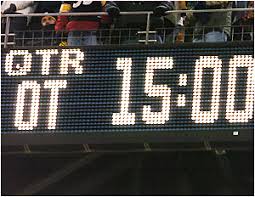
 College Football Overtime Rules
After four quarters of play and all the ways a football team can score, it is sometimes surprising when a college football game goes into overtime. Overtime in college football is handled much differently than the regular rules of football. Whenever a game ends in a tie, you can rest assured that the discussion about college football overtime rules will start and there will be a lot of folks with a lot of different information. So, let’s take a moment to lay it out for you.
College Football Overtime Rules
When the game ends in a tie after regulation (that means the normal time a game is supposed to last), they flip a coin to decide who starts with the ball and what end of the field will be used.
Each team has a chance to start at the 25 yard line closest to the goal they are trying to score in. From there, they have the same rules to score. They have just the one possession and start with 4 downs. They can get first downs every 10 yards. They can score a touch down or a field goal for points or the other team can stop them from scoring or intercept a pass or recover a fumble to end the possession too. The only real difference is they won’t punt the ball.
When they are done with their possession and whatever it results in (points or no points), the other team then gets the same chance. If after the first overtime (both teams having a possession), both teams are still tied (they both got the same number of points), then they will do the same thing again for the 2nd overtime. If a tie is still in place after 2 overtimes, then the teams must go for 2 points if they score a touchdown until one of the teams comes up with more points.
That’s pretty much it but for a more in depth look at Overtime Rules, click here.